

73: ICECAP: The Results


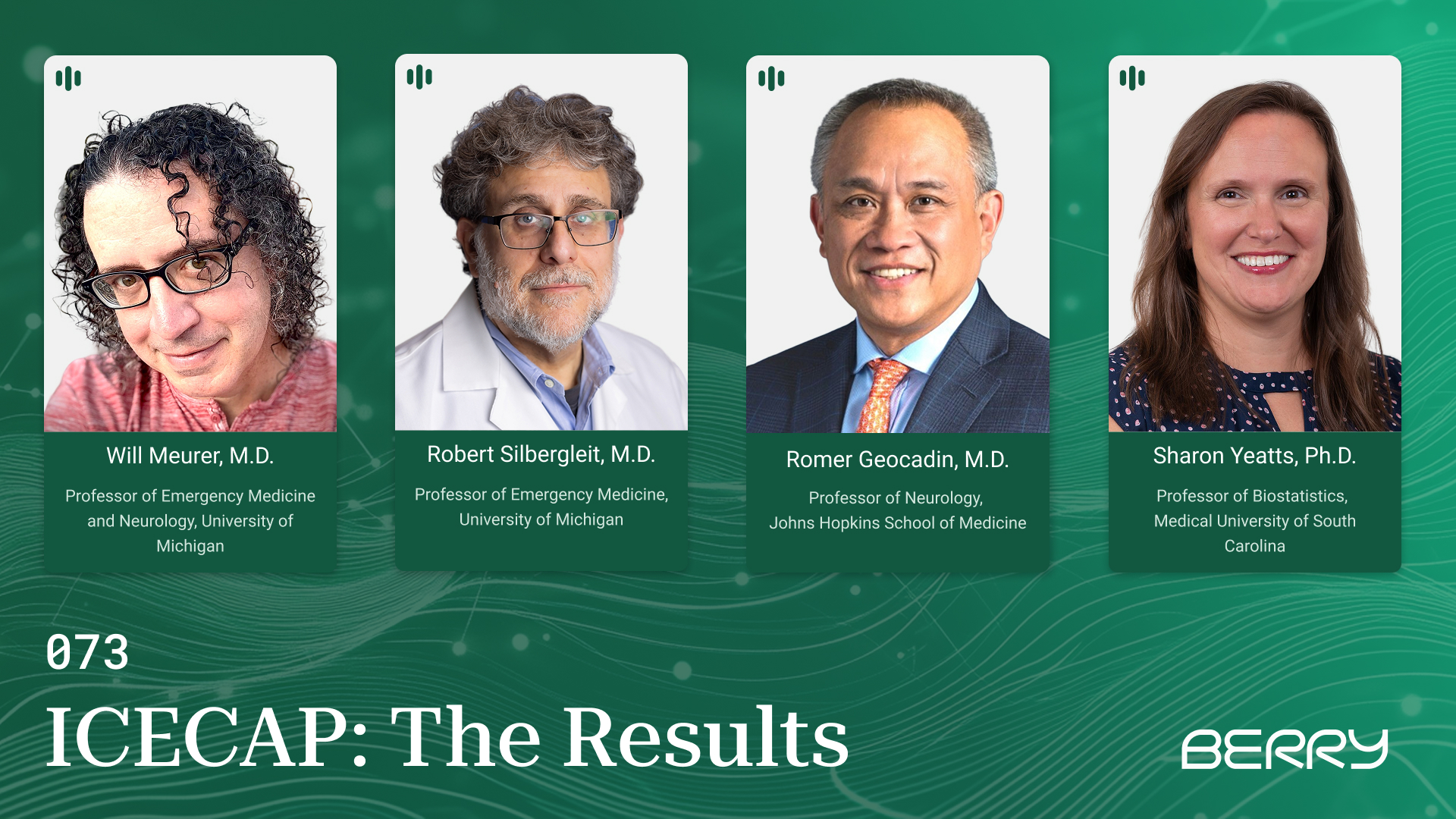
In this episode of "In the Interim…", Dr. Scott Berry leads a comprehensive discussion of the ICECAP trial results with four Principal Investigators: Dr. Will Meurer (Professor, Emergency Medicine and Neurology, University of Michigan; consultant to Berry Consultants), Dr. Robert Silbergleit (Professor, Emergency Medicine, University of Michigan Medical School), Dr. Romer Geocadin (Professor, Neurology, Neurosurgery, and Anesthesiology and Critical Care Medicine, Johns Hopkins University School of Medicine), and Dr. Sharon Yeatts (Professor of Biostatistics, Public Health Sciences, Medical University of South Carolina). The panel dissects the ICECAP trial’s multi-arm Bayesian adaptive design, response-adaptive randomization, and population-level approach to cooling duration after out-of-hospital cardiac arrest. Emphasis is placed on methodological transparency, direct operational experience, absence of evidence for incremental benefit beyond six hours of cooling, and future direction for neurocritical care trials.
Key Highlights
Detailed review of adaptive design methodology, Bayesian interim analyses, and stopping criteria for futility based on posterior probabilities
Analysis of flat duration-response curve: no clinical benefit seen for extended hypothermia, trial triggered to stop per prespecified rule
Cohort discussion: representation of U.S. epidemiology, inclusion of heterogeneous etiologies (notably respiratory and overdose) and bystander CPR rates
Operational challenges: running frequent interim analyses, maintaining trial integrity during COVID-19, site-level differences, statistical reporting timelines
Panel consensus on the need for continued equipoise in temperature management, caution against misinterpretation, and priority for precision subgroups in future research
Directions: implementation lessons, pediatric ICECAP, PRECISE-CAP phenotyping study, ongoing subgroup analyses