
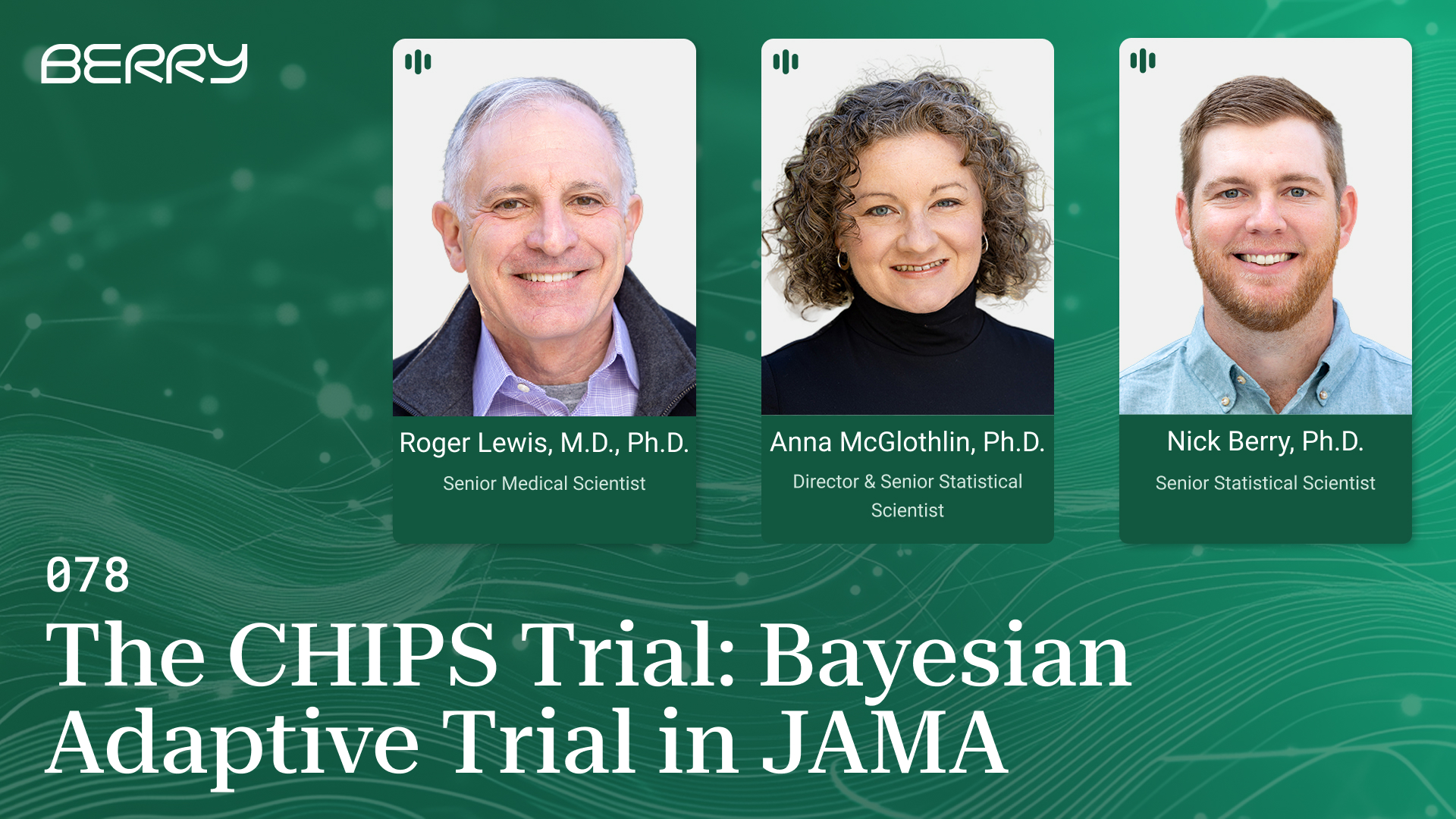

78: The CHIPS Trial: Bayesian Adaptive Trial in JAMA


In this episode of “In the Interim…,” Dr. Scott Berry talks with Dr. Roger Lewis, Dr. Anna McGlothlin, and Dr. Nick Berry — all co-authors on the CHIPS trial results recently published in JAMA (Spinella et al., August 2026) — about the design, implementation, and results. The conversation covers why room-temperature platelets, which can be stored only five to seven days, leave rural hospitals, low-volume centers, and military and disaster settings without a reliable supply, and how a Bayesian adaptive design was used to find the maximum safe cold-storage duration rather than testing a single fixed duration. Roger, Anna, and Nick walk through the monotonic dose-response model that governed escalation, an unplanned mid-trial complication when the FDA independently authorized fourteen-day cold storage, and how the Data Safety Monitoring Board reviewed results within days of each interim. The trial ultimately demonstrated non-inferiority of cold-stored platelets out to twenty-one days with a Bayesian probability greater than 99.9%, offering a path to expanding platelet access in settings where it was previously very challenging.
Key Highlights
Cold-stored platelets tested as a potential answer to platelet shortages in rural, low-volume, and military/disaster settings.
Bayesian adaptive design used to find the maximum safe cold-storage duration, not just test a single fixed duration.
A monotonic dose-response model constrained escalation to a pre-specified, safety-first ladder across four interim analyses.
Mid-trial complication: an independent FDA decision allowing 14-day cold storage, absorbed into the design without unblinding.
Non-inferiority demonstrated out to 21 days of cold storage, with a Bayesian probability greater than 99.9%.
Interim data turned around by the unblinded implementation team in five business days, versus the six weeks often assumed for adaptive trials.
Implications for platelet access in disaster, military, and low-volume hospital settings, and for how shelf-life-dependent products are tested going forward.